Voted Best
Marketing & Content
Management Platform
Marketing & Content
Management Platform
Customize your demo
Oops! Something went wrong while submitting the form.

June 3, 2026
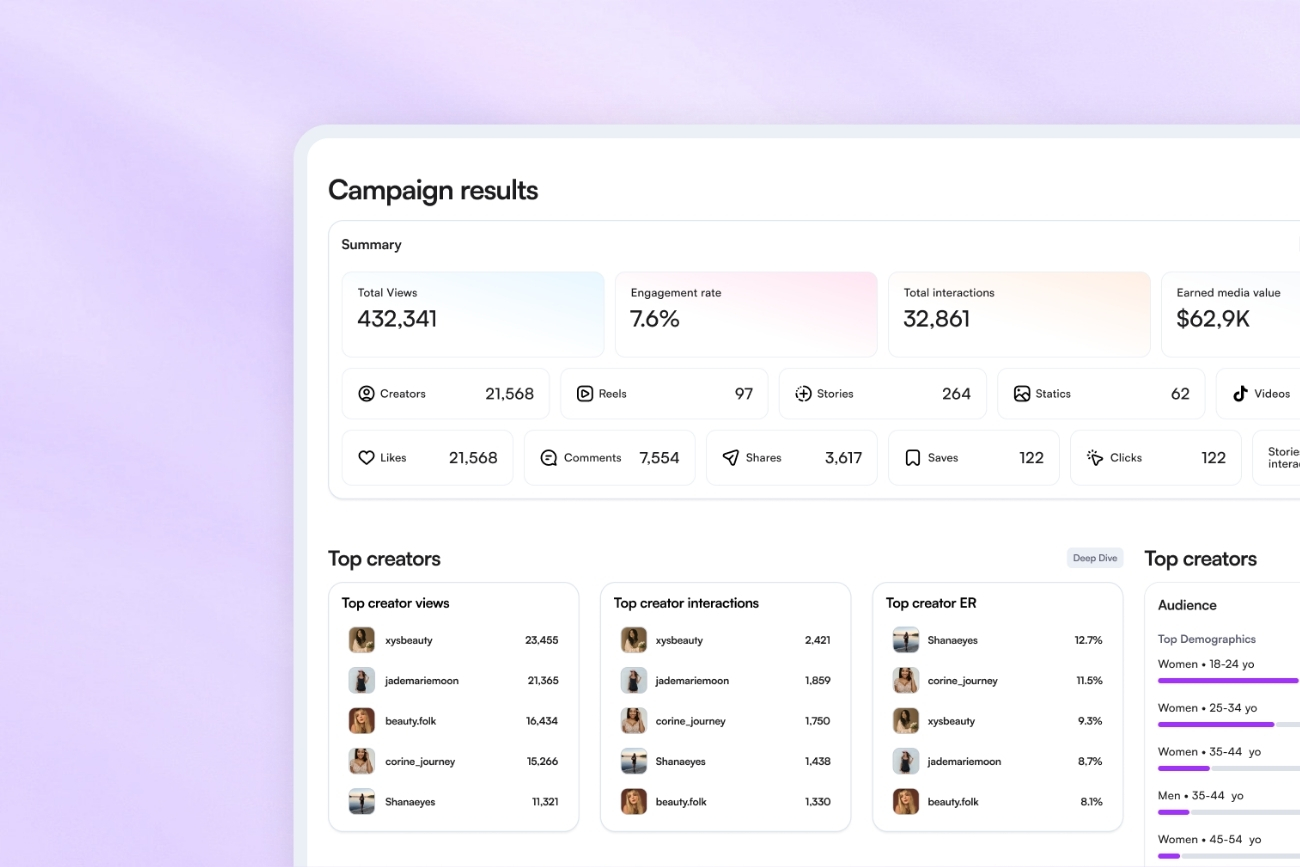
One of the biggest mistakes brands make after a campaign is focusing only on surface-level metrics like views or likes. While those numbers can help give a general overview, they rarely tell the full story on their own. The more valuable insights often come from deeper engagement signals and the way audiences are actually reacting to the content: comments, saves, shares, profile visits, and overall audience behaviour can all reveal how people truly interacted with a campaign. For example, if the goal of a campaign is awareness, one of the most important indicators to monitor is often non-follower reach. Is the content expanding beyond the creator’s existing audience? Is it reaching people who weren’t previously familiar with the brand? A creator with lower overall engagement but strong non- follower reach may actually be introducing your brand to entirely new communities more effectively than a creator with a larger but more saturated audience.
On the other hand, if the goal is conversion or product interest, the quality of comments becomes extremely valuable. Are people asking where the product is from? Requesting links, reviews, or more details? Those are often much stronger indicators than views alone. The same applies to saves and shares. Content that people save for later or send to friends tends to have a much longer lifespan and usually reflects stronger audience connection.The most useful data rarely lives in one metric alone, it comes from identifying patterns across multiple signals.
Once the data starts coming in, the next step is understanding what specifically drove performance. Not every creator will perform the same way. Some creators may drive strong engagement but lower conversions, while others may generate fewer overall views but extremely high audience intent. This is usually where brands start noticing patterns between creators and content formats. Did tutorial-style videos outperform aesthetic lifestyle content? Did casual talking videos generate stronger comments than polished edits? Did creators who integrated the product naturally into their routines see better audience response? Sometimes, the difference isn’t the creator, it’s the framing. Small shifts in messaging can completely change how audiences respond. In many cases, the strongest-performing content isn’t the most produced or visually perfect. Audiences often respond more strongly to content that feels spontaneous, relatable, and genuinely integrated into the creator’s everyday life.
This is also where brands start learning what kind of messaging resonates most with their audience:
• Was the content focused on product features or personal experience?
• Did creators educate, entertain, or simply showcase?
• Did the product feel naturally integrated into the story or inserted into it?
Over time, these are the kinds of patterns that completely change how brands build future campaigns. Instead of relying on assumptions, teams begin making decisions based on repeated audience behaviour and real campaign insights.
The real value of campaign analysis isn’t the report itself, it’s what happens next. Once brands identify which creators, formats, and messaging angles performed best, thoseinsights should directly shape future campaigns.
In practice, this often means re-engaging creators who consistently drive strong engagement, adjusting deliverables based on the formats that performed best, refining briefs to encourage more natural integrations, or testing new creator profiles based on emerging patterns. It’s also important to evaluate performance with nuance. Underperforming content does not automatically mean a creator is a poor fit overall. Sometimes the issue is timing, format, platform behaviour, or simply the campaign objective itself. A creator who underperformed in an awareness campaign may still excel in a UGC-focused activation. A creator with lower reach may produce exceptionally strong content for paid amplification. The goal isn’t simply to rank creators, it’s to understand how different creators contribute differently depending on the role they play within a campaign. This is where long-term tracking becomes extremely valuable. Over time, brands begin building a much clearer understanding of:
• which creators drive awareness
• which creators generate stronger trust signals
• which creators produce highly reusable content
• which creators consistently resonate with specific audiences
That historical context quickly becomes one of the most valuable assets in creator marketing.
One of the most overlooked mistakes brands make is treating creator content as temporary. In reality, strong-performing content can continue generating value long after the original campaign ends.
Organic creator content can often be repurposed for:
• paid social ads
• website product pages
• newsletters
• future seasonal campaigns
• organic social content
Sometimes, a creator video that performed moderately well organically becomes an extremely strong paid asset because the content feels authentic and relatable in a way traditional advertising often doesn’t. This is another reason post-campaign analysis matters. It helps brands identify not only which creators performed well, but which pieces of content have long-term reuse potential. Instead of viewing campaigns as isolated moments, brands start building a library of creator content and performance insights that compound over time. Platforms like Heylist support this process by keeping creator performance, campaign history, deliverables, and communication in one place. Instead of manually revisiting spreadsheets or searching through old emails, brands can compare creator results more efficiently, identify top- performing partnerships faster, and build a clearer long-term understanding of what consistently performs best.
One of the biggest shifts happening in creator marketing is that brands are starting to realize the campaign itself is not the finish line. The brands that improve year after year aren’t necessarily the ones running the most campaigns. They’re the ones learning the most from the campaigns they already run. Because in the end, creator marketing isn’t just about launching content, it’s about understanding what resonates, what drives action, and how to build stronger campaigns over time. The campaign may end, but the insights shouldn’t. That’s what turns creator marketing from isolated campaigns into a long-term strategy.


.jpg)